
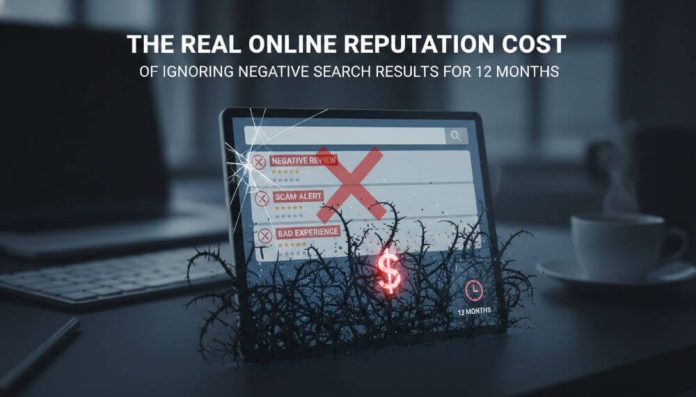
Most businesses don’t notice the damage right away.
A negative article shows up. A bad review climbs to the top of the results. Maybe a Reddit thread starts gaining traction. It doesn’t feel urgent at first. Traffic looks stable. Leads are still coming in.
So it gets ignored.
Twelve months later, the impact is no longer subtle. It’s baked into how people see your business before they ever click.
That’s the real cost of online reputation. Not the initial hit, but the slow, compounding effect of doing nothing.
Negative Search Results Don’t Just Sit There. They Compound
When negative content ranks on the first page of Google, it doesn’t stay static.
It attracts engagement. It gets referenced elsewhere. It becomes part of the broader narrative around your brand.
And because Google prioritizes relevance and interaction, that visibility tends to reinforce itself.
The higher it ranks, the more people see it.
The more people see it, the more signals it generates.
The more signals it generates, the harder it is to displace.
That loop is what most businesses underestimate.
What starts as a single result quietly turns into a pattern across your search presence.
Pasted text
The First Impact Isn’t Reputation. It’s Behavior
Before there’s any measurable brand damage, there’s a shift in user behavior.
People click less. They hesitate more. They bounce faster.
Even if they don’t consciously register why, negative search results influence how they interact with everything else they see.
This is where the cost of online reputation begins to show up in numbers.
Lower click-through rates.
Shorter time on site.
Fewer conversions.
Nothing dramatic at first. Just enough to start pulling performance down.
By Mid-Year, It Becomes a Trust Problem
After a few months, the issue evolves.
It’s no longer just about visibility or engagement. It’s about perception.
When negative content consistently appears in search, it starts to shape expectations. People assume there’s something wrong, even if they don’t fully investigate.
This is where trust erodes quietly.
Not because of one piece of content, but because of repetition. The same signals appear repeatedly across searches.
At that point, you’re not just losing clicks. You’re losing confidence.
And once that shifts, everything downstream becomes harder. Sales conversations. Hiring. Partnerships. Retention.
Competitors Don’t Have to Outperform You. They Just Have to Look Safer
Around the halfway point, another dynamic kicks in.
Competitors start benefiting.
Not because they improved, but because you look riskier by comparison.
When someone searches your brand and sees negative results, they don’t need to dig deep. They simply move on.
That traffic doesn’t disappear. It gets redirected.
To competitors with cleaner search results.
To businesses that look more stable.
To options that feel like a safer choice.
This is one of the most overlooked parts of the cost of online reputation. It’s not just what you lose. It’s what someone else gains because of it.
By the End of the Year, the Damage Is Structural
After twelve months, the problem isn’t just visibility or trust. It’s positioning.
Negative content has had time to settle into your search ecosystem. It’s been indexed, reindexed, referenced, and reinforced.
At that point, removing it or pushing it down becomes significantly harder.
You’re no longer dealing with a single result. You’re dealing with:
- Multiple pieces of related content
- Stronger authority signals behind those pages
- A search pattern that now expects that narrative
This is where the cost of online reputation becomes very real.
Not just in lost revenue, but in the effort required to reverse it.
Recovery Is Always Harder Than Prevention
One of the biggest misconceptions is that you can always fix it later.
Technically, you can. But the timeline changes.
What might have taken a few months to address early on can take years once the damage is established.
That’s because recovery isn’t just about removing or suppressing content. It’s about rebuilding authority.
You have to create new signals strong enough to compete with what’s already ranking. You have to shift perception, not just visibility.
And that takes consistency, not quick fixes.
Why Most Businesses Wait Too Long
The reason this happens so often is simple.
There’s no immediate trigger.
No alert that says, “This will cost you in six months.”
No clear moment where it feels urgent enough to act.
The impact builds gradually. It hides inside normal fluctuations in traffic and performance.
Until it doesn’t.
By the time the connection becomes obvious, the situation is already more complex than it needed to be.
Where Strategy Changes the Outcome
Addressing negative search results early doesn’t require overreaction. It requires awareness.
Understanding which content matters.
Knowing what can be removed versus what needs to be managed.
Building enough positive signals to prevent one result from dominating.
That’s the difference between controlling your search presence and reacting to it.
This is where experienced reputation teams—like NetReputation—tend to approach things differently.
Instead of focusing only on removing content, the strategy centers on how search results evolve over time. What gains traction? What fades. What can be influenced?
Because the goal isn’t just to fix a problem.
It’s to prevent it from becoming permanent.
The Cost Isn’t Immediate. That’s Why It’s Dangerous
If ignoring negative search results caused instant damage, most businesses would act quickly.
But it doesn’t.
It spreads slowly. Quietly. Almost invisibly at first.
Which is exactly why it becomes so expensive.
The real online reputation cost isn’t what happens when the content appears.
It’s what happens when it stays there—and everything around it starts to shift because of it.